Page 74 - RSE - Results of the Apollon Project
P. 74
Results of the APolloN PRoject ANd coNceNtRAtiNg PhotovoltAic PeRsPective
The mirrors and secondary optical elements (SOE) are composed of aluminium foil with an optical coating.
The Extended Unit Receiver comprises the 32 receiver units (including the triple junction solar cell, the receiver
substrate, connectors, bypass diode and adhesives), as well as 32 secondary optic assemblies (SOE), and 32 heat
sinks affxed to the base plate with thermal adhesive.
As a commercial solar cell, it has been selected SpectroLab (Product no. C3P5) triple junction (GaInP/GaInAs/Ge)
on a germanium substrate. A single 4” germanium wafer provides 192 cells, each with an optical area of 30.7 mm2.
A full life cycle analysis of SpectroLab GaIP/GaInAs/Ge cells was reported as having a value of 20.4 MJ embedded
energy, and emitting 0.885 kg CO -eq of greenhouse gas emissions per fully fabricated wafer (i.e. 192 cells).
2
Extruded aluminum components include: support for receiver, base frame, mirror frame and window frame
components, heat sink and support for receiver. Extruded aluminum is considered to contain 88% recycled aluminum.
Aluminum sheets are modeled in simapro as including the burden and credit of 79% recycled aluminum.
The system is envisioned to have one DC/DC converter and one PSD sensor per six 32-cell modules. Every module
has a breather component to avoid capturing humidity within the module. The DC/DC converter weighs a total of
600 g and is composed of a plastic housing and 400 g of electronics (source: Tecnalia). The PSD sensor weighs 0.95
kg, of which 0.075 is electronics and the rest is aluminium housing (source: RSE).
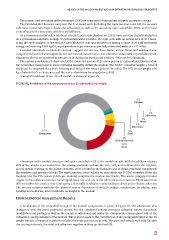
A weight breakdown of one 32-cell module is shown in Figure 82.
FiguRE 82. Breakdown of the components of one 32-cell module by weight
0%
Process
1%
Adhesives
1%
Metal
1%
Electronics
67% 4%
Aluminium Steel
4%
Coating materials
22%
glass
Aluminum in the module structure and optics contribute 67% to the module weight. With the addition of glass,
89% of the weight is accounted for. The coating materials include the TiO , SiCl and methanol for the TiO /SiO
2 4 2 2
sol-gel optical coatings on the mirror elements. Steel is found in the fasteners and in small structural components
like brackets and interface blocks. The triple junction solar cell, the by-pass diode, the DC/DC converter (1/6th per
module) and the PSD sensor (1/6th per module) comprise the module electronics. The metal category includes
copper in the cables, and various metals (gold, lead, zinc and tin) in the substrate and connectors. There were three
different adhesives used: a structural epoxy, a thermally conductive epoxy (without silver) and a silicone adhesive.
The process category captures the physical vapour deposition of optical coatings, anodization, tin plating, wire
bonding and soldering, and contributes no weight to the module.
Environmental Assessment Results
A breakdown of the embedded energy of the module components is given in Figure 83. The aluminium also
dominates with the most embedded energy, but the combined coating processes (physical vapour deposition,
anodization and plating) as well as the energy to wire bond and solder the components claims about 10% of the
cumulative energy demand of the module. This is about equal to the contribution of the energy embedded in the 1%
weight fraction of electronics (which includes the triple junction solar cell). The glass and metals each take 5% with
the coating materials, the steel and adhesives together making up the fnal 8%.
73