Page 16 - RSE - Results of the Apollon Project
P. 16
Results of the APolloN PRoject ANd coNceNtRAtiNg PhotovoltAic PeRsPective
desired temperature profle in between the two extremes. Since the gas fow and composition can be adjusted at
any time during the growth process, the MOCVD reactor can adapt to any strain-induced wafer bow and can, thus,
keep the wafer surface temperature constant by boosting thermal transport either at the center or the edge of the
satellite.
For the technical implementation of this principle, however, further considerations must be taken into account.
Firstly, the total gas fow to the satellite must not drop under the gas fow level required to keep the satellite afoat.
This would result in a stalled satellite severely impairing the growth of the solar cell structure. Secondly, the inner
and outer gas volume can, by design, not be kept hermetically separated. Interdiffusion of inner and outer gas must
be taken into account in the design and must, as far as possible, be inhibited.
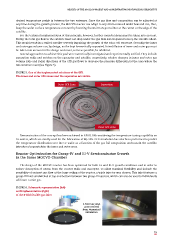
Several approaches to achieve this goal were numerically investigated and experimentally verifed. They include
separation walls and notches on the susceptor and satellite, respectively, relative changes in inner and outer gas
volume ratio and radial directions of the GFR gas fows to decrease the pressure differential at the area where the
two volumes meet (see Figure 5).
FiguRE 5. One of the implemented solutions of the GFR.
The inner and outer GFR zones and the separation are visible
Outer GFR Zone Separation
Separation
Outer gFR Zone
Inner GFR Zone
inner gFR Zone
Demonstration of the concept has been achieved in APOLLON considering the temperature tuning capability on
Ge wafers, which are mostly used for the fabrication of MJ cells. CFD simulation has also been performed to predict
the temperature distribution over the Ge wafer as a function of the gas foil composition underneath the satellite
introduced separately in the inner and outer zone.
Reactor Optimization for group-iv and iii-v Semiconductor growth
in the Same MOCvd Chamber
The design of the MOCVD reactor has been optimized for both Ge and III-V growth conditions and in order to
reduce desorption of atoms from the reactor walls and susceptor. To allow maximal fexibility and include the
possibility of an inert gas fow at the large ceiling of the reactor, a triple injector was chosen. This inlet features a
group-III inlet sandwiched at top and bottom between two group-V injectors, which can also be used to individually
add inert carrier gas.
FiguRE 6. Schematic representation (left)
and implementation (right)
of the 3-fold fexible gas inlet
3-fold gas inlet
Zone derived
from Numerical
Simulation
15