Page 24 - RSE - Results of the Apollon Project
P. 24
22 Results of the APOLLON project and Concentrating Photovoltaic perspective
From Figure 12 a) , it is possible to point out that a 37% efficient MJ solar cell working at 500 X has a cost per watt
lower than a 44% efficient MJ solar cell working at 300 X, and from Figure 12 b) it is possible to point out that a 37%
efficient MJ solar cell obtained with a process yield of 90%, has a cost per watt lower than a 44% efficient MJ solar
cell obtained with a process yield of 65%. It comes that efficiency it is not the only parameters which should drive
the solar cell component development. A simplified equation can then be utilized to analyse the weight of the CEPI
on the overall CPV system cost: Results of the APolloN PRoject ANd coNceNtRAtiNg PhotovoltAic PeRsPective
κ 1 κ 2
+
cos =
+
κ
t
(1)
CPV
System
The frst term of equation (1) takes into account the solar cell cost per Watt, the second term takes into account
3
η
CEPI
the tracker and module cost per Watt, while the third one takes into account the costs per Watt which do not depend
c
The first term of equation (1) takes into account the solar cell cost per Watt, the second term takes into account the
on the solar cell effciency value, like the inverter and BOS costs; k1, k2 and k3 are constants that depend on the cost
tracker and module cost per Watt, while the third one takes into account the costs per Watt which do not depend on
of the different CPV components.
the solar cell efficiency value, like the inverter and BOS costs; k1, k2 and k3 are constants depending on the cost of
The equation (1) holds under two hypothesis: solar cell un-yielded cost is considered constant, regardless of the
effciency value; the module, the tracker and the fxed costs are considered constant, regardless of the concentration
the different CPV components.
factor.
The equation (1) holds under two hypothesis:
For a better understanding of the starting assumption, see chapter 12 (Research areas to be further addressed).
• solar cell un-yielded cost is considered constant, regardless the efficiency value;
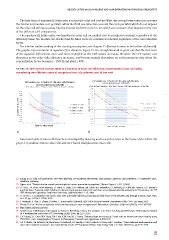
The graphic representation of equation (1) is shown in Figure 13. It is straightforward to point out that the frst term
• the module, the tracker and the fixed costs are considered constant, regardless the concentration factor.
of the equation (1) becomes more and more negligible as the CEPI values increases, therefore the CPV system cost
For a better understanding of the starting assumption, see chapter 12 (Where the research has to be further
decreases as the solar cells effciency increases, and become mainly dependent on such parameter only when the
addressed). The graphic of equation (1) is reported in Figure 13. It is straightforward to point out that the first term
concentration factor becomes > 1500 X and yield ≥ 80%.
of the equation (1) becomes more and more negligible as much as the CEPI values increases, therefore the CPV
system cost decreases as the solar cells efficiency increases, and become mainly dependent on
FiguRE 13. CPV system cost per Watt as a function of solar cell effciency, concentration factor and yield, such parameter only
when the concentration factor becomes > 1500 X and yield ≥ 80%.
considering two different cases of component cost: a) moderate cost, b) low cost
(Cell= 4 €/cm2, Module = 155 €/m2 €, tracker = 80 €/m2, fixed cost = 0.39 €/W)
a)
b)
a) b)
Two main kinds of solar cells have been developed by Industry and research centres in the frame of the APOLLON
Figure 13. CPV system cost per Watt in function of solar cell efficiency, concentration factor and yield, considering two different
project: crystalline Silicon solar cells and III-V based multijunction solar cells.
cases of component cost: a) moderate cost, b) low cost.
Two main kinds of solar cells have been developed by Industry and research centre in the frame of the APOLLON
project: crystalline Silicon solar cells and III-V based multijunction solar cells.
Crystalline Silicon Solar cells for CPV
Since the time of the birth of the photovoltaic industry, crystalline silicon solar cells were considered expensive for
terrestrial application and concentration photovoltaic started to emerge as a promising solution to reduce their
12 R.King at al. Solar Cell generations over 40% effciency, 26 European Photovoltaic Solar Energy Conference and Exhibition, 5-9 September 2011,
th
22,23
. The interest on very high efficiency cSi solar cell for CPV application continued since the middle of 1990s till
cost Hamburg, Germany.
13 Pijpers at al. “Photoexcitation cascade and multiple hot-carrier generation in grapheme”, Nature Physics, 5, 811 ( 2009).
2214 J.F. Geisz, S.R. Kurtz, M.W. Wanlass, J.S. Ward, A. Duda, D.J. Friedman, J.M. Olson, W.E. McMahon, T.E. Moriarty, J.T. Kiehl, M.J. Romero, A.G. Norman,
A Vision for Crystalline Silicon Photovoltaics.- R. M. Swanson Prog. Photovolt: Res. Appl. 2006; 14:443–453 DOI 10.1002/pip rd
23
and K.M. Jones, “Inverted GaInP / (In)GaAs / InGaAs Triple-Junction Solar Cells with Low-Stress Metamorphic Bottom Junctions” Presented at the 33
Photovoltaic Concentration at the Onset of its Commercial Deployment Prog. Photovolt: Res. Appl. 2006; 14:413–428
IEEE Photovoltaic Specialists Conference San Diego, California May 11–16, 2008.
15 A. Le Bris, J.-F. Guillemoles, Hot-carrier solar cells: achievable effciency accounting for heat losses in the absorber and through contacts, Appl. Phys.
Lett. 97, pp. 113506-113508, 2010.
16 S. Wojtczuk, P. Chiu, X. Zhang, D. Pulver, C. Harris and B. Siskavich, 42% 500X Bi-Facial Growth Concentrator Cells, CPV-7 Las Vegas 2011.
17 Verma, D. at al. “Review on up/down conversion materials for solar cell application” Photovoltaic Specialists Conference (PVSC), 2012 38 IEEE.
th
18 http://optics.org/news/2/4/22.
19 Daniel C.law, D.M.Bhusari, S.Mesropian, J.C.Boisvert, W.D.Hong, A.Boca, D.C.Larrabee, C.m. Fetzer. R.R King and N.H.Kram, “Semiconductor-bonded
III-V multijunction space solar cell”, Proceeding of IEEE 2009, pp. 2237-2239.
20 C.K. Huang, Y.C. Chen, W.B. Hung, T.M. Chen, K.W. Sun, W.-L. Chang, “Enhanced light harvesting of Si solar cells via luminescent down-shifting using
YVO4:Bi3+, Eu3+ nanophosphors” Progress in Photovoltaic: Research and Application, 6 JUN 2012.
21 T.N.D.Tibbits, I.M.Ballard, K.W.J.Barnham, D.B.Bushnell, J.P.Connolly, G.Hill, J.S.Roberts, R.Airey and G. Smekens, “Strain-balanced multi quantum well
th
solar cells in tandem strctutures- frst experimental results, 19 Europeam. Photov. Solar Energy Conf. 7-11 June 2004, Paris, pp 3715-3718.
23
From Figure 12 a) , it is possible to point out that a 37% efficient MJ solar cell working at 500 X has a cost per watt
lower than a 44% efficient MJ solar cell working at 300 X, and from Figure 12 b) it is possible to point out that a 37%
efficient MJ solar cell obtained with a process yield of 90%, has a cost per watt lower than a 44% efficient MJ solar
cell obtained with a process yield of 65%. It comes that efficiency it is not the only parameters which should drive
the solar cell component development. A simplified equation can then be utilized to analyse the weight of the CEPI
on the overall CPV system cost: Results of the APolloN PRoject ANd coNceNtRAtiNg PhotovoltAic PeRsPective
κ 1 κ 2
+
cos =
+
κ
t
(1)
CPV
System
The frst term of equation (1) takes into account the solar cell cost per Watt, the second term takes into account
3
η
CEPI
the tracker and module cost per Watt, while the third one takes into account the costs per Watt which do not depend
c
The first term of equation (1) takes into account the solar cell cost per Watt, the second term takes into account the
on the solar cell effciency value, like the inverter and BOS costs; k1, k2 and k3 are constants that depend on the cost
tracker and module cost per Watt, while the third one takes into account the costs per Watt which do not depend on
of the different CPV components.
the solar cell efficiency value, like the inverter and BOS costs; k1, k2 and k3 are constants depending on the cost of
The equation (1) holds under two hypothesis: solar cell un-yielded cost is considered constant, regardless of the
effciency value; the module, the tracker and the fxed costs are considered constant, regardless of the concentration
the different CPV components.
factor.
The equation (1) holds under two hypothesis:
For a better understanding of the starting assumption, see chapter 12 (Research areas to be further addressed).
• solar cell un-yielded cost is considered constant, regardless the efficiency value;
The graphic representation of equation (1) is shown in Figure 13. It is straightforward to point out that the frst term
• the module, the tracker and the fixed costs are considered constant, regardless the concentration factor.
of the equation (1) becomes more and more negligible as the CEPI values increases, therefore the CPV system cost
For a better understanding of the starting assumption, see chapter 12 (Where the research has to be further
decreases as the solar cells effciency increases, and become mainly dependent on such parameter only when the
addressed). The graphic of equation (1) is reported in Figure 13. It is straightforward to point out that the first term
concentration factor becomes > 1500 X and yield ≥ 80%.
of the equation (1) becomes more and more negligible as much as the CEPI values increases, therefore the CPV
system cost decreases as the solar cells efficiency increases, and become mainly dependent on
FiguRE 13. CPV system cost per Watt as a function of solar cell effciency, concentration factor and yield, such parameter only
when the concentration factor becomes > 1500 X and yield ≥ 80%.
considering two different cases of component cost: a) moderate cost, b) low cost
(Cell= 4 €/cm2, Module = 155 €/m2 €, tracker = 80 €/m2, fixed cost = 0.39 €/W)
a)
b)
a) b)
Two main kinds of solar cells have been developed by Industry and research centres in the frame of the APOLLON
Figure 13. CPV system cost per Watt in function of solar cell efficiency, concentration factor and yield, considering two different
project: crystalline Silicon solar cells and III-V based multijunction solar cells.
cases of component cost: a) moderate cost, b) low cost.
Two main kinds of solar cells have been developed by Industry and research centre in the frame of the APOLLON
project: crystalline Silicon solar cells and III-V based multijunction solar cells.
Crystalline Silicon Solar cells for CPV
Since the time of the birth of the photovoltaic industry, crystalline silicon solar cells were considered expensive for
terrestrial application and concentration photovoltaic started to emerge as a promising solution to reduce their
12 R.King at al. Solar Cell generations over 40% effciency, 26 European Photovoltaic Solar Energy Conference and Exhibition, 5-9 September 2011,
th
22,23
. The interest on very high efficiency cSi solar cell for CPV application continued since the middle of 1990s till
cost Hamburg, Germany.
13 Pijpers at al. “Photoexcitation cascade and multiple hot-carrier generation in grapheme”, Nature Physics, 5, 811 ( 2009).
2214 J.F. Geisz, S.R. Kurtz, M.W. Wanlass, J.S. Ward, A. Duda, D.J. Friedman, J.M. Olson, W.E. McMahon, T.E. Moriarty, J.T. Kiehl, M.J. Romero, A.G. Norman,
A Vision for Crystalline Silicon Photovoltaics.- R. M. Swanson Prog. Photovolt: Res. Appl. 2006; 14:443–453 DOI 10.1002/pip rd
23
and K.M. Jones, “Inverted GaInP / (In)GaAs / InGaAs Triple-Junction Solar Cells with Low-Stress Metamorphic Bottom Junctions” Presented at the 33
Photovoltaic Concentration at the Onset of its Commercial Deployment Prog. Photovolt: Res. Appl. 2006; 14:413–428
IEEE Photovoltaic Specialists Conference San Diego, California May 11–16, 2008.
15 A. Le Bris, J.-F. Guillemoles, Hot-carrier solar cells: achievable effciency accounting for heat losses in the absorber and through contacts, Appl. Phys.
Lett. 97, pp. 113506-113508, 2010.
16 S. Wojtczuk, P. Chiu, X. Zhang, D. Pulver, C. Harris and B. Siskavich, 42% 500X Bi-Facial Growth Concentrator Cells, CPV-7 Las Vegas 2011.
17 Verma, D. at al. “Review on up/down conversion materials for solar cell application” Photovoltaic Specialists Conference (PVSC), 2012 38 IEEE.
th
18 http://optics.org/news/2/4/22.
19 Daniel C.law, D.M.Bhusari, S.Mesropian, J.C.Boisvert, W.D.Hong, A.Boca, D.C.Larrabee, C.m. Fetzer. R.R King and N.H.Kram, “Semiconductor-bonded
III-V multijunction space solar cell”, Proceeding of IEEE 2009, pp. 2237-2239.
20 C.K. Huang, Y.C. Chen, W.B. Hung, T.M. Chen, K.W. Sun, W.-L. Chang, “Enhanced light harvesting of Si solar cells via luminescent down-shifting using
YVO4:Bi3+, Eu3+ nanophosphors” Progress in Photovoltaic: Research and Application, 6 JUN 2012.
21 T.N.D.Tibbits, I.M.Ballard, K.W.J.Barnham, D.B.Bushnell, J.P.Connolly, G.Hill, J.S.Roberts, R.Airey and G. Smekens, “Strain-balanced multi quantum well
th
solar cells in tandem strctutures- frst experimental results, 19 Europeam. Photov. Solar Energy Conf. 7-11 June 2004, Paris, pp 3715-3718.
23