Page 34 - RSE - Results of the Apollon Project
P. 34
Results of the APolloN PRoject ANd coNceNtRAtiNg PhotovoltAic PeRsPective
made an accurate study focusing on the optimization of a cone-shaped refective secondary optical elements. The
effciency of the whole concentrator system has been calculated as a function of different focal lengths of the
primary optical elements and of the SOE half-angle aperture including in presence of misalignments.
The best results have been obtained using the following parameters:
p lens aperture: 40x40mm square;
p focal length: 70mm;
p pitch of the lens tooth: 0,25mm
p secondary optical element aperture half-angle: 21°;
p secondary optical element height: 25 mm.
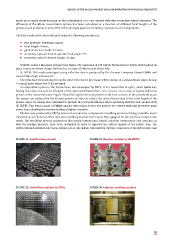
SolarTec made a fnal lens parquet (see Figure 27) composed of 144 silicon Fresnel lenses (array 12x12) glued on
glass. Indoor test have shown the lens has an optical effciency of about 84%.
SE SRTIIE SOE made prototypes using refective sheets produced by the German Company Alanod GMBH and
named “Miro high refective 95”.
The SOEs have been integrated on the solar cell receiver (see Figure 28) by means of a polyurethane plate, having
9 conical holes where the SOEs are fxed.
An alternative option to the Fresnel lens, was developed by ENEA. It is a novel kind of optic, called hybrid lens,
having the same size and focal length of the optimized Fresnel lens. It is consists of an array of square refractive
prisms in the central area (see Figure 29) and the typical Fresnel grooves at the four corners. In the peripheral areas,
the prisms are replaced by the Fresnel grooves in order to reduce the optical losses due to the total length of the
prisms edges. Its design was optimized to provide the best performance when operating with the SOE produced by
SE SRTIIE. The lens is made of PMMA and for this reason it does not need to be covered with any protective glass
sheet, thus allowing the manufacturing of lighter modules.
The lens was produced by CRP by means of an injection-compression moulding process utilizing a metallic insert
mounted on an electrical 70ton injection moulding machine (see Figure 30), equipped for the injection-compression
mode. The moulding process parameters like mould temperature, plastic injection temperature and pressure, as
well the holding pressure, have been optimized in order to improve the optical quality of the plastic lens. The
optical characterization has been carried out on the whole concentrator system composed of the hybrid lens and
FiguRE 27. SolarTec lens parquet FiguRE 28. Receiver realized by SE SRTIIE
FiguRE 29. Hybrid lens realized by ENEA FiguRE 30. Injection molding machine
33