Page 43 - RSE - Results of the Apollon Project
P. 43
Results of the APolloN PRoject ANd coNceNtRAtiNg PhotovoltAic PeRsPective
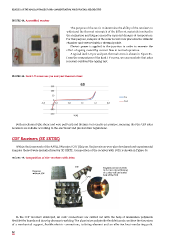
FiguRE 44. Assembled receiver
The purpose of the test is to determine the ability of the receivers to
withstand the thermal mismatch of the different materials involved in
the realization and fatigue caused by repeated changes of temperature.
For this purpose, samples of the solar receiver are placed in the climatic
chamber and stressed with a thermal profle.
Electric power is applied to the junction in order to recreate the
effect of ageing caused by current fow in normal operation.
A typical dark I-V pre and post thermal stress is shown in Figure 45 .
From the comparison of the dark I-V curves, we can conclude that solar
receivers survived the ageing test.
FiguRE 45. Dark I-V measures pre and post thermal stress
Both mechanical (die shear and wire pull test) and lifetime test results are positive, meaning that the CRP solar
receivers are reliable according to the electronic and photovoltaic regulations.
COF Receivers (SE SRTIIE)
Within the framework of the APOLLON project COF (Chip on Flex) receivers were also developed and experimental
samples thereof were manufactured by SE SIIRTE. Composition of the receiver with SOEs is shown in Figure 46.
FiguRE 46. Composition of COF-receivers with SOEs
SOE
Fragment of the receiver
Receiver in the area of positioning
without SOE of a solar cell and outlet
hole of the SOE
3 pcs.
In the COF-receivers developed, all cells’ connections are carried out with the help of aluminium-polyimide
fexible flm boards and done by ultrasonic welding. The aluminium-polyimide fexible boards combine the functions
of a mechanical support, fexible electric connections, isolating element and an effective heat-conducting path.
42