Page 47 - RSE - Results of the Apollon Project
P. 47
Results of the APolloN PRoject ANd coNceNtRAtiNg PhotovoltAic PeRsPective
In order to obtain a high level of precision, PSDs require high precision analogue electronics that is capable of
acquiring the signals and minimize any effects of the environmental noise. This adds a problem of cost. The sensor
also features non-linearity when the spot is located away from its center detection area and near the electrodes.
The CCD sensor requires digital electronics: the main requirement of such electronics is a scanning rate adequate
to avoid the saturation of the charge accumulated in the sensitive elements (pixels). The spatial resolution depends
on the number of pixels: the higher the number of pixels, the higher the resolution. An higher number of pixel
requires, however, higher performance by the digital electronic board in term of scanning and processing speed. For
this reason, usually a CCD sensor requires a digital acquisition system that is not low cost (such as a PC or a FPGA).
the Problem of the tracking Accuracy Sensors installation (tAS)
One of the main problems common to all tracking accuracy sensors or PSD is that they must necessarily be
installed on a plane that is coplanar with the photovoltaic module: the maximum misalignment error between
the sensor and module planes must be much smaller than the module acceptance angle. If the two planes are not
coplanar, in fact, the solar tracker will control the perfect alignment of the sensor with the Sun but not the actual
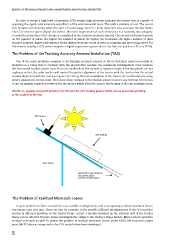
module alignment with the Sun (see Figure 51). During the frst installation of the tracker, the technicians, by using
proper adjustment screws, make the sensor’plane coplanar to the module plane. However, any thermal effects may
create an angular mismatch between the two planes which alters the proper functioning of the sun pointing sensor.
FiguRE 51. Angular mismatch between the PSD and the CPV module planes which causes inaccurate pointing
of the module to the Sun
PSD sensor
CPV module
Solar traker
Mismatch angle between
the sensor plane
and the module plane
the Problem of Residual Mismatch Losses
In spite of the best efforts to track the sun, variable misalignments and consequently, residual mismatch losses,
can always arise over time. These are due, for example, to the possible different misalignments of the CPV modules
located in different positions on the tracker frame. In fact, a module installed on the external part of the tracker
frame can be affected by more severe misalignments owing to the tracker’s frame fexure. Mirror defects generate
residual mismatch as well. To reduce the problem of residual mismatch losses, under APOLLON maximum power
point (MPPT) devices integrated in the CPV module have been developed.
46